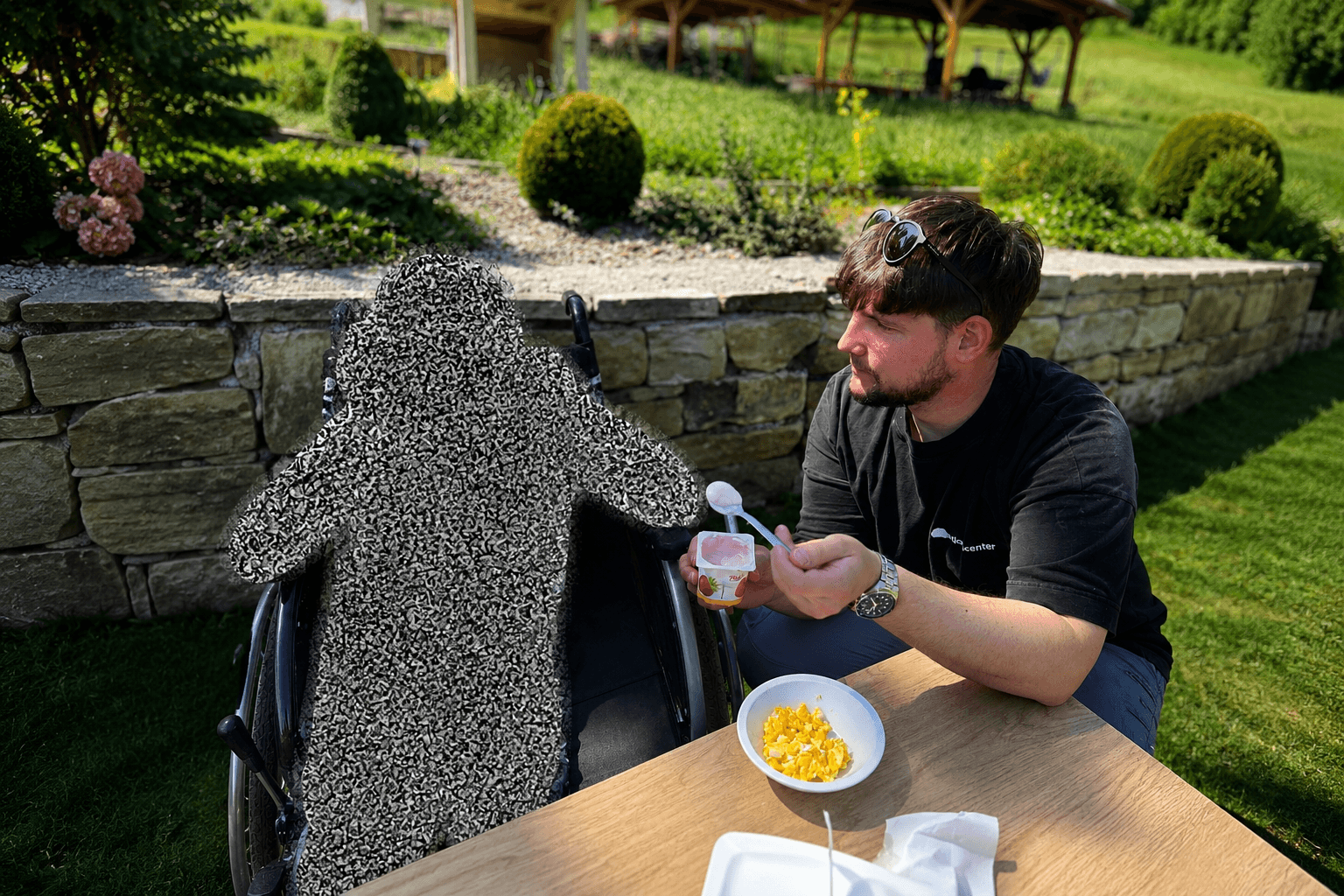
I've been thinking more about leadership lately.
Not so much about leadership as a position or a title, but about what happens when other people are actually entrusted to us. What do they experience when they spend time with us? What do they learn from the way we speak, the way we react, the way we treat people when things don't go our way?
And, for those of us who follow Jesus, there is a question underneath all of that that I find much harder to answer:
What do people see of Jesus when they see me?
I don't think I have a perfect answer to that. If anything, the more I think about it, the more aware I am of how much I still have to learn.
But there are a few things I keep coming back to.
I know what it means to be on the other side
I was thinking recently about a conversation I had years ago in a camp.
Someone sat down with me and talked.
That's really all that happened.
There wasn't a big moment that everyone noticed. There wasn't anything particularly impressive about the conversation itself. But for me, it became the last piece in a process through which I eventually surrendered control of my life to Jesus.
I don't think that person knew what was happening.
They probably didn't leave that conversation thinking they had just helped change someone's life. As far as they knew, they had simply spent some time talking with me.
But God used it.
I've carried that thought with me ever since, because it changes the way I look at people and at the seemingly insignificant things we do for them.
We usually don't know which conversation matters.
We don't know what someone has been carrying before they walk into the room.
We don't know how much courage it took for them to finally say something.
We don't know whether the few minutes we spend listening will be forgotten tomorrow or remembered twenty years from now.
And I think that's okay.
We aren't called to know the outcome of everything we do. We are called to be faithful with what God puts in front of us.
Sometimes that means having the conversation.
Sometimes it means noticing the person everyone else missed.
Sometimes it means staying a little longer.
Sometimes it means praying for someone when they don't even know that you are doing it.
Those things can look very small from our side.
They may not be small at all on the other side.
The towel
One of the passages I've been thinking about is John 13.
Jesus knows exactly who He is. He knows that the Father has given everything into His hands. He knows where He came from and where He is going.
And then He gets up from the table, takes a towel, pours water into a basin and starts washing the disciples' feet.
I think there is something important in the fact that Jesus knew who He was before He took the towel.
He wasn't serving because He needed to prove that He was humble. He wasn't giving up His authority. He wasn't becoming less because He got down on the floor.
He knew who He was, and that made Him free to serve.
That's quite different from the way I sometimes approach leadership.
It's easy to become attached to being the person who decides, the person who knows, the person people listen to. Even when we start with the right intentions, responsibility can slowly turn into a desire for control.
Jesus takes the towel.
And when He finishes washing their feet, He tells His disciples that He has given them an example.
I don't think the lesson is really about feet.
It's about what we are willing to do with whatever position, influence or responsibility God has given us.
Sometimes serving means doing something nobody will notice.
Sometimes it means giving someone else the credit.
Sometimes it means listening when you're tired.
Sometimes it means admitting that you were wrong.
Sometimes it means putting aside something you wanted to do because someone else needs you.
There is nothing particularly glamorous about those things.
But then again, there wasn't anything glamorous about a basin of water either.
I've been thinking about four words that help me remember what this kind of leadership should look like:
Love. Service. Listening. Faith.
I like the simplicity of it.
Love
It starts with seeing people properly.
Not just seeing what they are doing, but trying to understand who they are.
We are very good at making quick judgments about people. We see someone's attitude, their mistakes, the way they speak, the way they react, and we can very quickly decide what kind of person they are.
But there is always more to the story.
Loving someone doesn't mean ignoring what is wrong. It means remembering that the person standing in front of us is more than the worst thing they've done or the most difficult part of their personality.
It also means being willing to love people who aren't particularly easy to love.
That one is harder.
It's easy to be patient with people we naturally like. It's harder when someone keeps frustrating us, disagrees with us or seems to constantly need more from us than we feel able to give.
But that's where love becomes real.
And maybe one of the greatest gifts we can give someone is simply to make them feel that they have been seen.
I've experienced that myself, and I haven't forgotten it.
Service
Then there is service.
I think we sometimes use the word so often that we forget what it actually costs.
Serving someone can be inconvenient.
It can mean giving up time we wanted for ourselves. It can mean doing something that doesn't match our position. It can mean helping without receiving any recognition.
The towel is a good reminder of that.
Jesus didn't wait for someone else to take care of the dirty work.
He took the towel Himself.
I think there is something very healthy about learning to ask, "What needs to be done?" instead of always asking, "Is this my responsibility?"
There will always be things that technically aren't our responsibility.
But love has a way of making us willing to help anyway.
Listening
I find this one particularly challenging.
We like to answer.
Someone tells us something and, before they have even finished, we're already thinking about what we should say next.
Sometimes people do need advice.
But sometimes they need someone who is willing to stay quiet long enough for them to finish their thought.
Listening requires us to put our own thoughts aside for a moment.
It also means being willing to hear things we don't necessarily like.
And if we want to represent Jesus, I think we need to become better at listening to God as well.
We can spend so much time talking about God, talking for God and trying to help other people that we forget to stop and listen ourselves.
We need Scripture. We need prayer. We need people who can correct us. We need enough humility to admit that our first instinct isn't always the right one.
Faith
And then there is faith.
Maybe this is where all of it eventually leads.
We can love someone deeply and still not be able to change them.
We can have the right conversation and still not see the result we hoped for.
We can pray and wait.
We can serve faithfully for years without knowing whether what we did mattered.
At some point, we have to trust God with the part that isn't ours.
I find that strangely comforting.
I'm responsible for faithfulness.
I'm not responsible for controlling the outcome.
That doesn't mean we stop caring. Quite the opposite. We care enough to do what we can, and then we trust God enough to let go of what we can't.
We are not the destination
There is something else I've had to think about when it comes to leadership.
People can start looking to us.
They trust us. They ask what we think. They come to us when they don't know what to do.
That's a privilege.
But it can also become something we start enjoying a little too much.
It's nice to be needed.
It's nice to feel important.
It's nice to know that people value what we say.
And that's where we have to be careful.
Because if we're leading people towards Jesus, then we can't quietly make ourselves the destination.
We're not.
Jesus is.
I don't want someone to look at my life and conclude that they need to become more like me.
I want them to see something that makes them want to know Jesus better.
That also means I don't have to pretend that I have everything figured out.
I can say that I don't know.
I can admit when I've made a mistake.
I can ask someone else for advice.
I can pray before answering.
I can point back to Scripture instead of trying to make myself the authority.
There is a certain freedom in knowing that it's not about me.
Looking at Jesus
I've been reading Philippians 3 again, and I keep thinking about Paul's attitude there.
He doesn't write as someone who has arrived at the destination.
He's still pressing on.
Still pursuing Christ.
Still running.
I find that important because sometimes leadership can make us feel like we need to have everything together before we can lead anyone else.
But I don't think that's the picture Scripture gives us.
We are still being shaped while we serve.
We are still learning.
Still failing.
Still being corrected.
Still discovering how much we need Jesus.
And that brings me back to the thought I've been carrying:
We cannot represent a Jesus we are not looking at.
I think that's true in a very practical way.
If I stop looking at Jesus, eventually people around me will experience more of my character than His.
They'll experience my impatience when I'm tired.
My pride when I'm challenged.
My need for control when things become uncertain.
My frustration when people don't behave the way I expect them to.
But when I keep looking at Jesus, I am reminded again and again of who He is.
I remember how patient He has been with me.
How much grace I've received.
How many times I've needed forgiveness.
I remember the way He treated people, especially the people everyone else had already decided were not worth much attention.
I remember the towel.
And I remember that before I ever tried to represent Him to anyone else, I was someone who needed Him to change me.
That's probably why I don't think Christian leadership is ultimately about becoming a better leader.
It's about becoming more like Jesus.
The leadership grows out of that.
Take the towel
There will always be things to organize, decisions to make, problems to solve and people to lead.
That's part of it.
But underneath all of that, I think the question remains quite simple.
Am I becoming someone who looks like Jesus?
Am I willing to love when it costs me something?
Am I willing to serve when nobody notices?
Am I willing to listen instead of always needing to speak?
Am I willing to trust God when I can't see what He is doing?
And when people spend time around me, do they see enough of Jesus to make them want to look at Him too?
I keep thinking about that conversation from years ago.
I still don't know what the person who had it with me thought about it afterwards.
Maybe they forgot it.
I didn't.
God used something that probably felt ordinary to them to do something extraordinary in me.
And maybe that's one of the strange and beautiful things about serving Him.
We don't always get to see what He does with our obedience.
Sometimes all we know is that we were there.
We listened.
We cared.
We prayed.
We took the towel.
And then we trusted Him with the rest.
I know He did that for me.
So I want to keep looking at Jesus.
Because if I'm going to represent Him, I don't want people to see a carefully constructed version of Christianity when they look at me.
I want them to see something real.
Something imperfect, but pointed in the right direction.
Something that makes them look past me and towards Him.
And maybe that's enough.
To keep our eyes on Jesus, take the towel when He asks us to, and trust Him with whatever He chooses to do through it.