In 1912, eight musicians continued playing as the Titanic sank. More than a century later, in a small town in Nepal, another man stayed behind while everyone else ran for their lives.
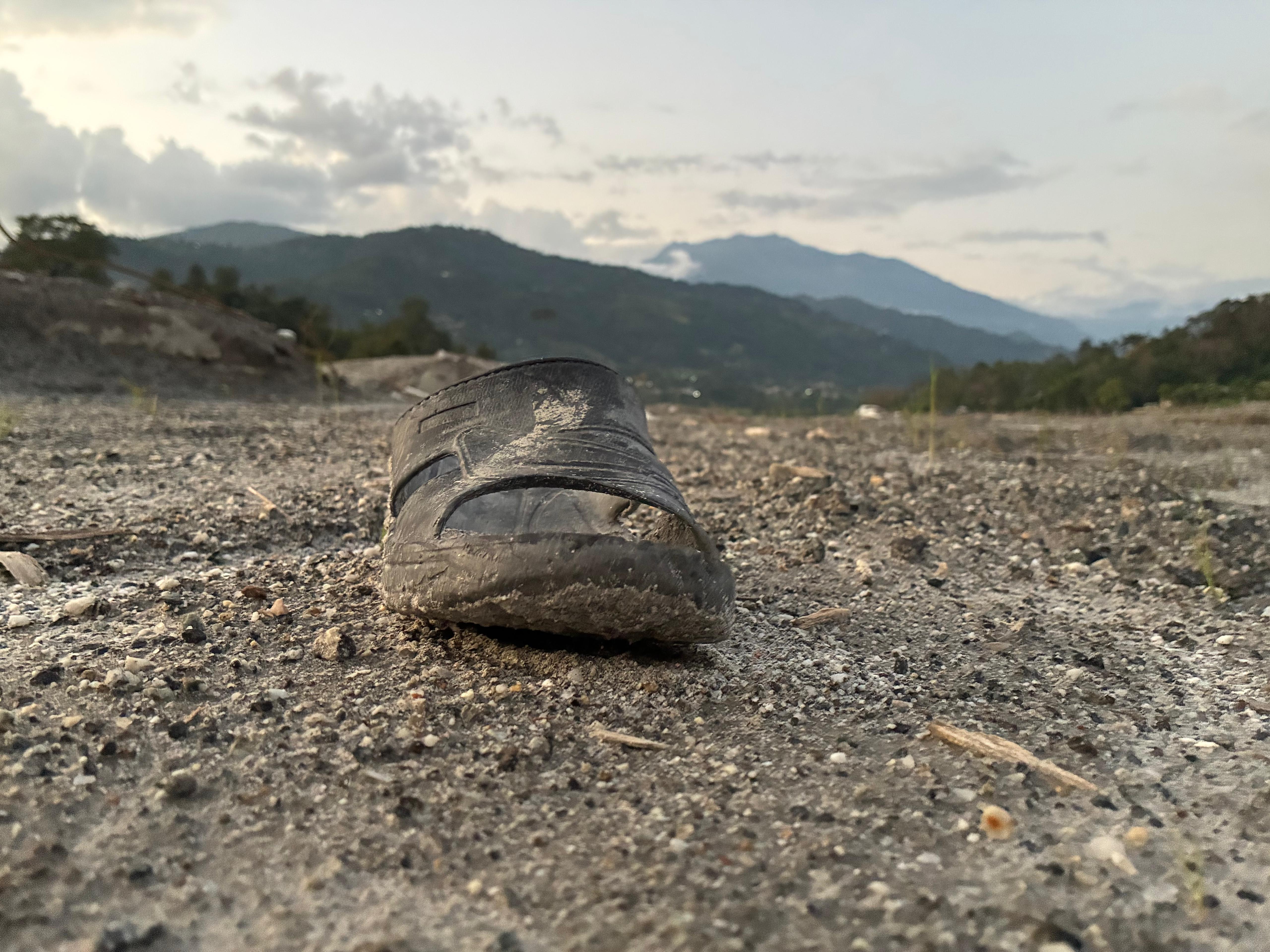
There was a slipper lying among the ruins of a school in Nepal.
Just one slipper.
I don't know who it belonged to. Perhaps a student lost it while running for his life. Perhaps it was carried there by the flood, along with everything else the water had torn from people's homes. I don't know whether its owner survived, or whether someone, somewhere, is still wondering what happened to the person who wore it.
I took a photograph.
It seemed such a terribly ordinary thing to find in a place where something so extraordinary and horrific had happened. A slipper. Something that belonged to someone's everyday life, abandoned in a place where everyday life had ceased to exist.
And behind it, the remains of a school.
On 26 August 2026, a catastrophic flood swept through the Trishuli Valley in Nepal. The water came down from the mountains with a violence that is difficult to comprehend, carrying mud, rocks, debris, and entire pieces of what had once been people's lives.
Buildings disappeared. Roads vanished. The river consumed places that had stood for generations.
Among them was a school.
That morning, hundreds of teenagers had arrived expecting another ordinary day. They had lessons to attend, friends to meet, and lives to live. They could not have known that within minutes, the place where they had spent so many of their childhood days would be gone.
Then came the warnings.
The flood was approaching.
The school bell rang. Teachers and staff hurried the students out of their classrooms and towards higher ground. There was no time to collect belongings, no time to understand the enormity of what was happening.
They had to run.
At the school gate stood a man whose job, on any other morning, would hardly have attracted anyone's attention.
He was the gatekeeper.
He was not a famous man. He held no grand title. His work was to guard the school, to watch over its entrance, to be there as children came and went.
But on that morning, the gate became the boundary between life and death.
He shouted at the teenagers to run uphill, urging them to hurry, to get away from the water. As people fled, he remained at his post, trying to make sure they escaped.
And then, according to the account we heard there, when the others had made their way out, he stayed behind to close the gate.
The flood came.
He did not escape.
The water swept him away.
Of all the things that happened that morning, I find myself returning to those final moments. I wonder whether he knew how close the water was. Whether he believed he still had time. Whether closing that gate was simply an instinct born from years of doing his job, or whether, even then, he was thinking about protecting the school.
I cannot know.
And I will not pretend to know what passed through the mind of a man in the final seconds of his life.
What I do know is that when the students were running towards safety, he was still there.
Three people connected to that school were lost in the disaster, according to what we were told. He was one of them.
And somewhere beyond the ruins, a woman was waiting for a husband who would not return.
I have often thought about the musicians aboard the Titanic.
On the night of 14 April 1912, as that magnificent ship began its descent into the Atlantic, eight men continued to play their instruments.
Around them, passengers were desperate to escape. Lifeboats were being lowered. The certainty of survival was slipping away with every passing minute.
Yet the music continued.
It could not save the ship. It could not hold back the ocean. But it offered something to the frightened people around them, a little order, perhaps even a little comfort, in a world that was suddenly falling apart.
None of those eight musicians survived.
For more than a century, their story has been remembered as one of the extraordinary examples of human courage in the face of death.
I thought about them as I stood among the ruins in Nepal.
There was no orchestra here. No grand ship, no elegant uniforms, no music carrying across the darkness of the Atlantic.
There was a school gate, a river that had become merciless, and a man shouting for children to run.
The musicians played so that others might find some peace in their final moments.
The gatekeeper shouted so that others might have many more moments to live.
Separated by an ocean, more than a century, and worlds of circumstance, they were united by something I find difficult to put into words.
When their own lives were in danger, they continued to think of others.
And none of them came home.
The musicians of the Titanic have monuments, books, films, and a place in history.
I wonder who will remember the gatekeeper from Nepal a hundred years from now.
I never met him.
But I met his wife.
My father and I were there, standing among the destruction, when we had the opportunity to speak with her.
We tried to encourage her. We prayed for her.
I have struggled to find the right words to describe that encounter ever since.
What can you possibly say to someone who has lost her husband in such circumstances?
What comfort can you offer when the person who should be standing beside her is gone?
I wish there were words powerful enough to make such grief bearable. I wish there were explanations that could somehow reconcile the goodness of what he did with the terrible price that followed.
But there aren't.
We could not bring him back. We could not repair what had been taken from her. We could only stand with her for a little while, offer our prayers, and hope that our presence might bring some measure of comfort.
I believe in God. I believe in prayer. I believe that even in the darkest circumstances, we are not abandoned by Him.
But faith does not mean pretending that tragedy is anything less than tragic.
There is a terrible emptiness in the thought of a woman who has lost her husband because, in the moments when he might have saved himself, he remained concerned for others.
The world may remember him as a hero.
She must live with his absence.
She is the one who has lost the ordinary things that make a life together. His voice. His company. The simple reassurance of knowing that someone you love will come home at the end of the day.
Those things are impossible to measure, and no amount of admiration can replace them.
I thought about that as we prayed.
And I think about it now.
Because I cannot write about his courage without also writing about what it cost the person who loved him.
We live in a world that has become terribly accustomed to tragedy.
A flood kills hundreds. An earthquake buries villages. A war takes thousands of lives. We read the numbers, perhaps watch a few videos, feel a moment of sorrow, and move on to the next piece of news.
I understand why. No human being can carry the full weight of all the suffering in the world.
But I wonder what we lose when human lives become statistics.
Three people.
It sounds like a small number when compared with the enormous scale of the devastation in Nepal.
Three, among so many others.
Yet for three families, the world has been changed forever.
One of those people was a gatekeeper. One had a wife whom I met. He had a life beyond the school, beyond his work, beyond the few minutes by which I now know his story.
He was more than the manner of his death.
And perhaps that is the most important thing I want to say about him.
I do not believe that dying makes someone a hero. Death is a terrible thing, and we should never make it seem desirable merely because courage preceded it.
I wish he had run. I wish he had closed that gate and somehow made it to safety. I wish the story ended with the children returning to their families and the man returning to his wife.
I wish we could celebrate him while he was still alive.
But we cannot change the ending.
We can only decide what we do with the story he left behind.
There is a passage in the Gospel of John that I have carried with me while thinking about him.
“Greater love has no one than this: to lay down one's life for one's friends.”
I cannot claim to know everything about this man's intentions. I do not know what he believed, what he feared, or whether he ever imagined anyone would speak about him after his death.
But I know that he spent those desperate moments calling others towards safety.
And in an age when we often measure the importance of a life by wealth, position, visibility, or influence, I find something profoundly humbling in the thought that one of the most remarkable examples of humanity I encountered in Nepal came from a man guarding a school gate.
He did not need an audience to do what he believed was right.
The children needed to escape.
And he stayed.
I keep returning to that photograph.
The little slipper lying among the remains of what had once been a place filled with young voices, laughter, lessons, and the ordinary noise of life.
I don't know who left it there.
I don't know whether anyone will ever come back to look for it.
Perhaps it belonged to someone who survived. I hope it did.
There is something about the things people leave behind that makes a tragedy almost unbearably real. Buildings can be rebuilt. Roads can be cleared. Classrooms can eventually fill with students again.
But somewhere, there will always be a woman whose husband never returned from work that day.
And somewhere, there are young people who are alive to remember the voices that told them to run.
I pray that God will comfort his wife, that she will never be left to carry her grief alone, and that the people who survived will find the strength to rebuild their lives.
I also pray that we might learn something from this man's final actions.
Not that we should seek death, or that suffering is somehow noble in itself, but that even when the world seems to be collapsing around us, there remains something worth preserving in the human heart.
The willingness to care.
The courage to act.
The extraordinary love that can be found in the most ordinary of people.
More than a century ago, eight men continued playing music on a sinking ship. We remember them still.
In Nepal, a gatekeeper stood at the entrance of a school and shouted for the children to run.
I hope we remember him, too.
I came home with a photograph of a slipper, and with the memory of a woman for whom we had prayed.
But somewhere in the Trishuli Valley, the story of a man who stayed behind deserves to outlive the flood that took him.
Because the water carried away the school, the gate, and so much of the life that had surrounded them.
It should not be allowed to carry away his memory.